4th Quarter 2025 Commentary
I really thought stocks would cool off in 2025. This is an unusually strong run, which I’ll get into shortly. But first, let’s take inventory. The S&P 500 rose nearly 18% for the year, led again by the technology sector, up 25%. A few of the big AI plays had staggering returns…again. The advance did turn out to be a little more egalitarian with the average S&P 500 stock up 11% and small caps rising close to 13%. Earnings were good. Once again, investors had little use for safety. The staples sector barely eked out a gain. Shifting to Q4, markets cooled off a bit. The S&P 500 rose 2.7%, with most sectors posting low single digit returns or less. The exception was healthcare; playing catch up, the sector rose nearly 13%. Small caps were up a little over 1%. Bonds had a good year…as bond returns go. The Bloomberg Aggregate Bond Index added over 7%. 10-year Treasury yields retreated from the high 4s to the low 4s, and the Fed cut the target rate three times beginning in September. Finally, this housekeeping wouldn’t be complete without a rare shout-out to international equity markets that on average outpaced U.S. returns in 2025, although the beats were generally less dramatic in local currencies given a very weak dollar. In any case, diversification finally did its job.
Normally, I’d spend a few sentences on the twists and turns of the past year, but somehow, old news seems even less important than normal this year. The S&P 500’s exceptional three-year run deserves special attention as it belies scary geopolitical facts and near universal concern for our own future. Here’s my take. (Be forewarned, this story begins in the late 1990s. Think Bill Clinton and the song Macarena.)
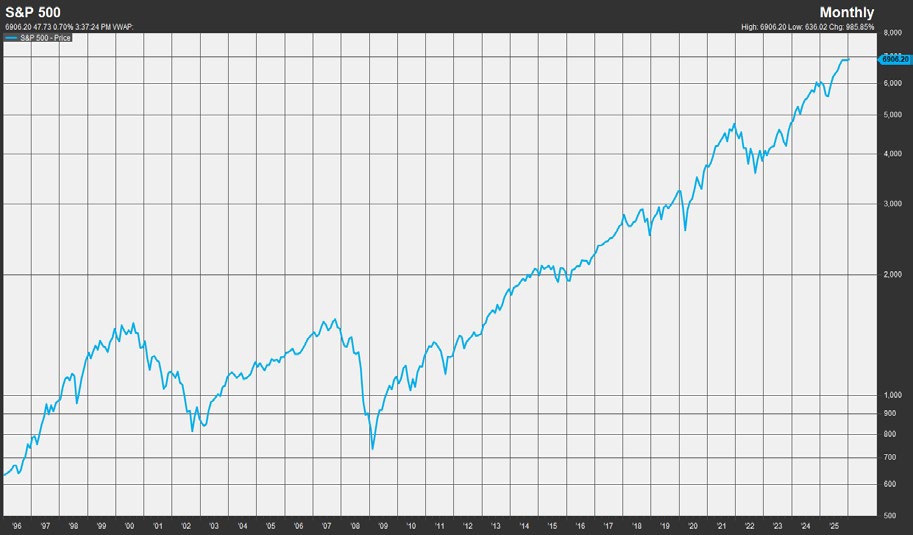
Borrowing from Mark Twain: history doesn’t exactly repeat, but it rhymes. The chart above shows the price of the S&P 500 over the last three decades. Apologies for the small print but it begins in 1996 at a value of around 650 and ends at 6900. Honestly, the only reason I remember 1996 at all is because of a term coined by the then-revered Fed Chairman, Alan Greenspan, who is about to celebrate his 100th birthday. The stock market had been on a tear following the early 1990’s recession. Greenspan mostly spoke in riddles and rarely commented on stocks, but on December 5th, 1996, he was concerned enough to utter the phrase “irrational exuberance” to describe investor’s obvious enthusiasm for stocks. It’s hard to exaggerate the inscrutability of most Greenspan speeches, and the market obsessed over his wording, but for some reason on that day he was quite clear…and wrong. It would be almost four years before the market actually peaked. In fact, the market doubled from the date of his speech, muscled along in the end by the rising dot-com bubble.
And this brings me to my first point. He was right to be concerned. I was a fresh-faced, bushy-haired portfolio manager back then and I agreed with him. But what we both couldn’t know was how the future would unfold. Specifically, we didn’t realize how thoroughly we would get swept up in the technological upheaval of the internet. It was better than we could have imagined for longer than we could have imagined before it got out of hand.
There are obvious parallels between 2025 and the late 1990s. Now as then we are somewhere in the middle of a massive technology product adoption cycle with unknowable consequences. Investors are rightly exuberant about the enormous spending and open-ended potential of AI. But there are also respected voices urging caution. Stocks aren’t cheap and after three years of outstanding gains, shouldn’t we be cautious?
I don’t generally fixate on things like that Greenspan speech, but it marked the beginning of an important and exceptionally stressful time in my career. While we were also concerned in late 1996, it would be another year or so before we concluded we were in a bubble, and two more years of being painfully wrong before we were vindicated. The point is: you never forget your first bubble. And right now, in my judgement we aren’t in one…yet. Valuations are defensible with much of the spending supported by profits and cash flows. At this point, there’s too much momentum behind AI spending and adoption to get negative on the outcome, even though we can’t know what that will look like.
One final thought on Greenspan’s speech: on that day the S&P 500 was around 700. It’s nearly 7000 today, a ten-bagger (price only). You’d have also collected dividends for 30 years. This seems almost too good to be true given we suffered a devastating bubble, the Great Recession and a global pandemic. Forgive me one last anecdote. We moved offices this year to a vibrant part of Richmond and I have a decent view of this little ecosystem. There’s residential, retail, restaurants, a couple of banks, and even the quintessential pharmacy/diner—classic Main St. USA. And not much different from circa 1996. But the S&P 500 is profoundly changed from that era. The secret sauce: it’s continuously being remade as time, knowledge and our economy march on. And that’s especially true when our uniquely robust technology flywheel is fully engaged.
While it can be unsettling, Wall Street and Main Street will continue to diverge. As your wealth manager it’s our job to help you invest in our exciting future, but we are acutely aware that exuberance can turn to excess.
Richard H. Skeppstrom II serves Brockenbrough as Managing Director and Chief Equity Strategist. He manages two of our investment products and writes most of our investment commentary. Richard joined the firm in 2016 and has 30 years of experience in the investment management industry.
The opinions expressed are those of Brockenbrough*. The opinions referenced are as of the date of publication and are subject to change due to changes in the market of economic conditions and may not necessarily come to pass. Forward looking statements cannot be guaranteed. Brockenbrough is an investment advisor registered with the U.S. Securities and Exchange Commission. Registration does not imply a certain level of skill or training. More information about Brockenbrough investment advisory services can be found in its Form ADV Part 2, which is available upon request.
*Lowe, Brockenbrough & Co. dba Brockenbrough
It Starts Here
Let’s get to know each other.
Existing Clients
Already part of the family?
4th Quarter 2025 Commentary